The arrangement
How a Queen song becomes a piece for two voices and a piano
What an arranger keeps, what they rebuild and what is lost when a rock band's sound is carried by a soprano, a tenor and a pianist.
Reserve your candlelit evening ↗Quick answer
A pianist can cover the harmony and rhythm of a rock song, and two trained voices can share the melody and the stacked harmonies that Queen built from tape. The tune survives; the wall of guitar does not. A concert like this is best heard as a translation of the songs, not as a copy of the records.
What carries over
| Usually kept | Usually changed | |
|---|---|---|
| Melody | The tune you know | Which voice sings it |
| Harmony | The chords | Thinned or redistributed on the piano |
| Backing vocals | The stacked harmonies | Shared between a soprano and a tenor |
| Sound | The emotional shape | Electric guitar and drums are gone |
From band to piano
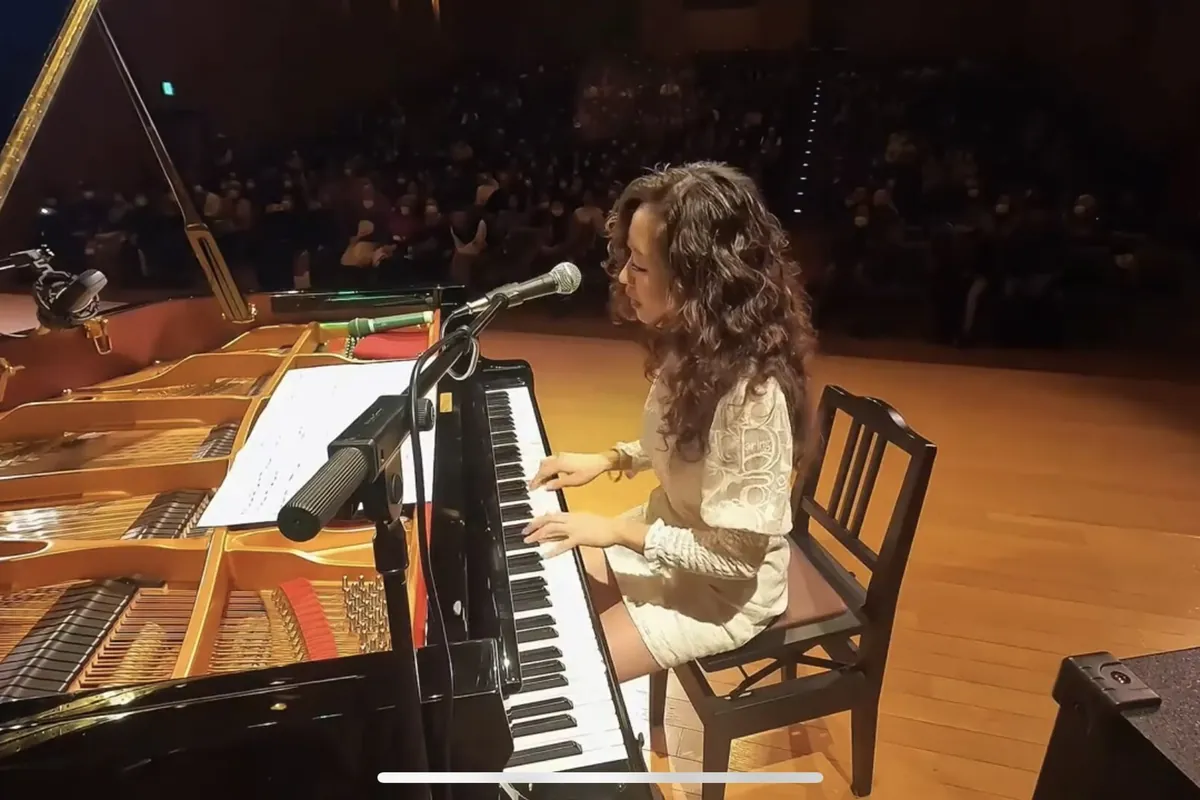
On Wikipedia, a piano reduction is a piano part distilled from a larger ensemble score, playable by one pianist. The idea applies readily to a rock song. A pianist can play the chords and the rhythm that a bass, drums and rhythm guitar supply, and can imitate a line of lead guitar in the right hand. Some detail is lost and other detail changes, which is why an arranger makes choices instead of transcribing every note. Where a band's sound is dense, the piano thins it; where the band is sparse, as in Love of My Life, which Wikipedia says Mercury wrote on piano and guitar, the piano is closer to home.
Two voices instead of four
Queen's records often leaned on layered vocals. Wikipedia says Somebody to Love was built by multitracking Mercury, May and Taylor to suggest a choir of one hundred, and that the opera section of Bohemian Rhapsody involved about 180 overdubs. A live arrangement for a soprano and a tenor cannot stack tape, so it chooses. The soprano may take the high lines, the tenor the lower, and each may sing the melody in turn. A soprano, Wikipedia explains, is the highest classical voice, while a tenor is the highest male classical voice that uses the chest register, so the pair covers a wide span. Singers trained to project in churches and opera houses can also fill a room without a microphone, which suits a candlelit venue.
What an aria adds
The programme sets Queen songs beside opera arias. Wikipedia calls an aria a standalone number for a single voice, normally inside a longer work, in contrast with recitative, the speech-like style that carries the plot. Arias are where opera stops to feel something, which is also what a power ballad does. Placing the two forms side by side lets a listener hear the kinship. The booking page does not name the arias, so this site does not either.
What you lose, and what you gain
You lose the guitar orchestra that Brian May built and the drive of a rhythm section. You gain clarity: with fewer layers, the words and the melodic shapes stand out, and the training of the singers brings out phrasing that a studio blend can hide. Different listeners prefer one or the other, and the 4.2 average from 916 reviews on the booking page suggests most are content with the trade. Go in expecting a reinterpretation, and you are likely to enjoy the places where it surprises you.
Frequently asked questions
Will it sound like the records?
No. The songs are arranged for a soprano, a tenor and a pianist.
Do the singers use microphones?
The booking page does not say, so this site does not claim either.
Sources
- Piano reduction (reference entry)
- Bohemian Rhapsody: release, structure and recording (reference entry)
- Soprano voice type (reference entry)
- Somebody to Love, the 1976 Queen single (reference entry)
- Love of My Life, the Queen ballad (reference entry)
- Tenor voice type (reference entry)
- Aria (reference entry)